Student's t-test
Student's t-test
A t-test is a type of statistical analysis used to compare the averages of two groups and determine whether the differences between them are more likely to arise from random chance. It is any statistical hypothesis test in which the test statistic follows a Student's t-distribution under the null hypothesis. It is most commonly applied when the test statistic would follow a normal distribution if the value of a scaling term in the test statistic were known (typically, the scaling term is unknown and is therefore a nuisance parameter). When the scaling term is estimated based on the data, the test statistic—under certain conditions—follows a Student's t distribution. The t-test's most common application is to test whether the means of two populations are different.
History[edit]

The term "t-statistic" is abbreviated from "hypothesis test statistic".[1] In statistics, the t-distribution was first derived as a posterior distribution in 1876 by Helmert[2][3][4] and Lüroth.[5][6][7] The t-distribution also appeared in a more general form as Pearson type IV distribution in Karl Pearson's 1895 paper.[8] However, the t-distribution, also known as Student's t-distribution, gets its name from William Sealy Gosset, who first published it in English in 1908 in the scientific journal Biometrika using the pseudonym "Student"[9][10] because his employer preferred staff to use pen names when publishing scientific papers.[11] Gosset worked at the Guinness Brewery in Dublin, Ireland, and was interested in the problems of small samples – for example, the chemical properties of barley with small sample sizes. Hence a second version of the etymology of the term Student is that Guinness did not want their competitors to know that they were using the t-test to determine the quality of raw material. Although it was William Gosset after whom the term "Student" is penned, it was actually through the work of Ronald Fisher that the distribution became well known as "Student's distribution"[12] and "Student's t-test".
Gosset had been hired owing to Claude Guinness's policy of recruiting the best graduates from Oxford and Cambridge to apply biochemistry and statistics to Guinness's industrial processes.[13] Gosset devised the t-test as an economical way to monitor the quality of stout. The t-test work was submitted to and accepted in the journal Biometrika and published in 1908.[9]
Guinness had a policy of allowing technical staff leave for study (so-called "study leave"), which Gosset used during the first two terms of the 1906–1907 academic year in Professor Karl Pearson's Biometric Laboratory at University College London.[14] Gosset's identity was then known to fellow statisticians and to editor-in-chief Karl Pearson.[15]
Uses[edit]
The most frequently used t-tests are one-sample and two-sample tests:
- A one-sample location test of whether the mean of a population has a value specified in a null hypothesis.
- A two-sample location test of the null hypothesis such that the means of two populations are equal. All such tests are usually called Student's t-tests, though strictly speaking that name should only be used if the variances of the two populations are also assumed to be equal; the form of the test used when this assumption is dropped is sometimes called Welch's t-test. These tests are often referred to as unpaired or independent samples t-tests, as they are typically applied when the statistical units underlying the two samples being compared are non-overlapping.[16]
Assumptions[edit]
[dubious ]
Most test statistics have the form t = Z/s, where Z and s are functions of the data.
Z may be sensitive to the alternative hypothesis (i.e., its magnitude tends to be larger when the alternative hypothesis is true), whereas s is a scaling parameter that allows the distribution of t to be determined.
As an example, in the one-sample t-test
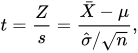
where X is the sample mean from a sample X1, X2, …, Xn, of size n, s is the standard error of the mean, is the estimate of the standard deviation of the population, and μ is the population mean.

The assumptions underlying a t-test in the simplest form above are that:
- X follows a normal distribution with mean μ and variance σ2/n.
- s2(n − 1)/σ2 follows a χ2 distribution with n − 1 degrees of freedom. This assumption is met when the observations used for estimating s2 come from a normal distribution (and i.i.d. for each group).
- Z and s are independent.
In the t-test comparing the means of two independent samples, the following assumptions should be met:
- The means of the two populations being compared should follow normal distributions. Under weak assumptions, this follows in large samples from the central limit theorem, even when the distribution of observations in each group is non-normal.[17]
- If using Student's original definition of the t-test, the two populations being compared should have the same variance (testable using F-test, Levene's test, Bartlett's test, or the Brown–Forsythe test; or assessable graphically using a Q–Q plot). If the sample sizes in the two groups being compared are equal, Student's original t-test is highly robust to the presence of unequal variances.[18] Welch's t-test is insensitive to equality of the variances regardless of whether the sample sizes are similar.
- The data used to carry out the test should either be sampled independently from the two populations being compared or be fully paired. This is in general not testable from the data, but if the data are known to be dependent (e.g. paired by test design), a dependent test has to be applied. For partially paired data, the classical independent t-tests may give invalid results as the test statistic might not follow a t distribution, while the dependent t-test is sub-optimal as it discards the unpaired data.[19]
Most two-sample t-tests are robust to all but large deviations from the assumptions.[20]
For exactness, the t-test and Z-test require normality of the sample means, and the t-test additionally requires that the sample variance follows a scaled χ2 distribution, and that the sample mean and sample variance be statistically independent. Normality of the individual data values is not required if these conditions are met. By the central limit theorem, sample means of moderately large samples are often well-approximated by a normal distribution even if the data are not normally distributed. For non-normal data, the distribution of the sample variance may deviate substantially from a χ2 distribution.
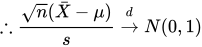
However, if the sample size is large, Slutsky's theorem implies that the distribution of the sample variance has little effect on the distribution of the test statistic. That is, as sample size increases:

- as per the Central limit theorem,
- as per the law of large numbers,
- .



Comments
Post a Comment