Unpaired and paired two-sample t-tests
Unpaired and paired two-sample t-tests[edit]


Two-sample t-tests for a difference in means involve independent samples (unpaired samples) or paired samples. Paired t-tests are a form of blocking, and have greater power (probability of avoiding a type II error, also known as a false negative) than unpaired tests when the paired units are similar with respect to "noise factors" (see confounder) that are independent of membership in the two groups being compared.[21] In a different context, paired t-tests can be used to reduce the effects of confounding factors in an observational study.
Independent (unpaired) samples[edit]
The independent samples t-test is used when two separate sets of independent and identically distributed samples are obtained, and one variable from each of the two populations is compared. For example, suppose we are evaluating the effect of a medical treatment, and we enroll 100 subjects into our study, then randomly assign 50 subjects to the treatment group and 50 subjects to the control group. In this case, we have two independent samples and would use the unpaired form of the t-test.
Paired samples[edit]
Paired samples t-tests typically consist of a sample of matched pairs of similar units, or one group of units that has been tested twice (a "repeated measures" t-test).
A typical example of the repeated measures t-test would be where subjects are tested prior to a treatment, say for high blood pressure, and the same subjects are tested again after treatment with a blood-pressure-lowering medication. By comparing the same patient's numbers before and after treatment, we are effectively using each patient as their own control. That way the correct rejection of the null hypothesis (here: of no difference made by the treatment) can become much more likely, with statistical power increasing simply because the random interpatient variation has now been eliminated. However, an increase of statistical power comes at a price: more tests are required, each subject having to be tested twice. Because half of the sample now depends on the other half, the paired version of Student's t-test has only n2 − 1 degrees of freedom (with n being the total number of observations). Pairs become individual test units, and the sample has to be doubled to achieve the same number of degrees of freedom. Normally, there are n − 1 degrees of freedom (with n being the total number of observations).[22]
A paired samples t-test based on a "matched-pairs sample" results from an unpaired sample that is subsequently used to form a paired sample, by using additional variables that were measured along with the variable of interest.[23] The matching is carried out by identifying pairs of values consisting of one observation from each of the two samples, where the pair is similar in terms of other measured variables. This approach is sometimes used in observational studies to reduce or eliminate the effects of confounding factors.
Paired samples t-tests are often referred to as "dependent samples t-tests".
Calculations[edit]
Explicit expressions that can be used to carry out various t-tests are given below. In each case, the formula for a test statistic that either exactly follows or closely approximates a t-distribution under the null hypothesis is given. Also, the appropriate degrees of freedom are given in each case. Each of these statistics can be used to carry out either a one-tailed or two-tailed test.
Once the t value and degrees of freedom are determined, a p-value can be found using a table of values from Student's t-distribution. If the calculated p-value is below the threshold chosen for statistical significance (usually the 0.10, the 0.05, or 0.01 level), then the null hypothesis is rejected in favor of the alternative hypothesis.
One-sample t-test[edit]
In testing the null hypothesis that the population mean is equal to a specified value μ0, one uses the statistic

where is the sample mean, s is the sample standard deviation and n is the sample size. The degrees of freedom used in this test are n − 1. Although the parent population does not need to be normally distributed, the distribution of the population of sample means is assumed to be normal.

By the central limit theorem, if the observations are independent and the second moment exists, then will be approximately normal .


Slope of a regression line[edit]
Suppose one is fitting the model

where x is known, α and β are unknown, ε is a normally distributed random variable with mean 0 and unknown variance σ2, and Y is the outcome of interest. We want to test the null hypothesis that the slope β is equal to some specified value β0 (often taken to be 0, in which case the null hypothesis is that x and y are uncorrelated).
Let

Then
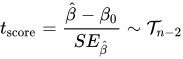
has a t-distribution with n − 2 degrees of freedom if the null hypothesis is true. The standard error of the slope coefficient:
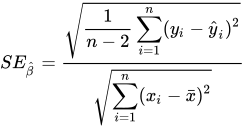
can be written in terms of the residuals. Let

Then tscore is given by
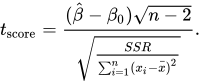
Another way to determine the tscore is
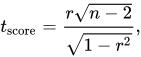
where r is the Pearson correlation coefficient.
The tscore, intercept can be determined from the tscore, slope:
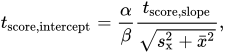
where sx2 is the sample variance.
Independent two-sample t-test[edit]
Equal sample sizes and variance[edit]
Given two groups (1, 2), this test is only applicable when:
- the two sample sizes are equal,
- it can be assumed that the two distributions have the same variance.
Violations of these assumptions are discussed below.
The t statistic to test whether the means are different can be calculated as follows:
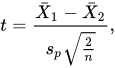
where
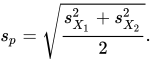
Here sp is the pooled standard deviation for n = n1 = n2, and s 2
X1 and s 2
X2 are the unbiased estimators of the population variance. The denominator of t is the standard error of the difference between two means.
For significance testing, the degrees of freedom for this test is 2n − 2, where n is sample size.
Equal or unequal sample sizes, similar variances (12 < sX1sX2 < 2)[edit]
This test is used only when it can be assumed that the two distributions have the same variance (when this assumption is violated, see below). The previous formulae are a special case of the formulae below, one recovers them when both samples are equal in size: n = n1 = n2.
The t statistic to test whether the means are different can be calculated as follows:
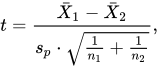
where
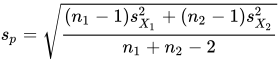
is the pooled standard deviation of the two samples: it is defined in this way so that its square is an unbiased estimator of the common variance, whether or not the population means are the same. In these formulae, ni − 1 is the number of degrees of freedom for each group, and the total sample size minus two (that is, n1 + n2 − 2) is the total number of degrees of freedom, which is used in significance testing.
Equal or unequal sample sizes, unequal variances (sX1 > 2sX2 or sX2 > 2sX1)[edit]
This test, also known as Welch's t-test, is used only when the two population variances are not assumed to be equal (the two sample sizes may or may not be equal) and hence must be estimated separately. The t statistic to test whether the population means are different is calculated as
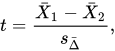
where
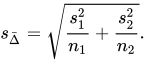
Here si2 is the unbiased estimator of the variance of each of the two samples with ni = number of participants in group i (i = 1 or 2). In this case is not a pooled variance. For use in significance testing, the distribution of the test statistic is approximated as an ordinary Student's t-distribution with the degrees of freedom calculated using

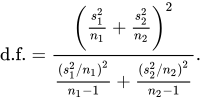
This is known as the Welch–Satterthwaite equation. The true distribution of the test statistic actually depends (slightly) on the two unknown population variances (see Behrens–Fisher problem).

Comments
Post a Comment